Field Log

Selected reservoir modelling engagements.

Structured the way we hand work back to clients: the brief, the geological problem, how we modelled it, and what it changed about the field's development plan.

⚠Mixed status. LOG 01–02 are illustrative placeholders pending client confirmation. LOG 03 is real, from our own in-preparation research manuscript (not yet peer-reviewed) — see its source note below.
LOG 01Draft

Natural-state and production-history calibration, high-enthalpy volcanic field

Central America · Andesitic stratovolcano-hosted system
Brief

Validate an updated equation-of-state formulation against 30+ years of well and production history before it was used for new development scenarios.

Challenge

Steep topography and a shallow magmatic heat source produce strong lateral temperature gradients that simple models under-predict.

Method

Multi-scenario natural-state and history-matched runs across the revised EOS, cross-checked against a combined-field simulation case.

Outcome

Confirmed EOS fix carried through to production forecasts; resource risk range tightened for the client's development committee.

LOG 02Draft

Natural-state model for a new exploration prospect

Undisclosed field · Early-stage exploration
Brief

Build a natural-state model from sparse exploration data to support a well-siting decision ahead of the first deep well.

Challenge

Limited well control meant permeability structure had to be inferred largely from surface geochemistry and resistivity surveys.

Method

Ensemble of plausible permeability structures run in parallel, ranked against surface manifestation temperatures and chemistry.

Outcome

Narrowed the candidate well-pad locations from five to two, with an explicit confidence range on target reservoir temperature.

LOG 03In prep. — own research

Combined development: Tecuamburro + Infiernitos, 25-year forecast

Tecuamburro Volcanic Complex, Guatemala · Two-resource joint development
Brief

Test whether developing Tecuamburro and Infiernitos as one combined project changes either resource's own forecast, using a framework where every combined-scenario sample shares the identical natural-state realisation, injection strategy and pump-sizing logic as its single-resource counterpart.

Challenge

Determine whether joint development causes genuine resource-scale interaction — shared pressure support, competition for reinjection capacity — or whether independent forecasts simply sum, and prove it at the level of reservoir pressure itself rather than inferring it from power output alone.

Method

293-sample stochastic ensemble; automated well-siting growth algorithm; source-network-coupled reinjection in Waiwera; matched sample-by-sample against each resource's independent forecast; interference tested directly via per-sample reservoir pressure at Infiernitos' own feedzones.

Outcome

Combined development changes each resource's own forecast by under 1% (Wasserstein-1 distance 0.13–0.38 MWe), and the distributions are not statistically distinguishable (Kolmogorov–Smirnov, p>0.05). A real but small hydraulic interference exists — 0.18 bar median pressure reduction at Infiernitos by year 25 — an order of magnitude below natural-state uncertainty.

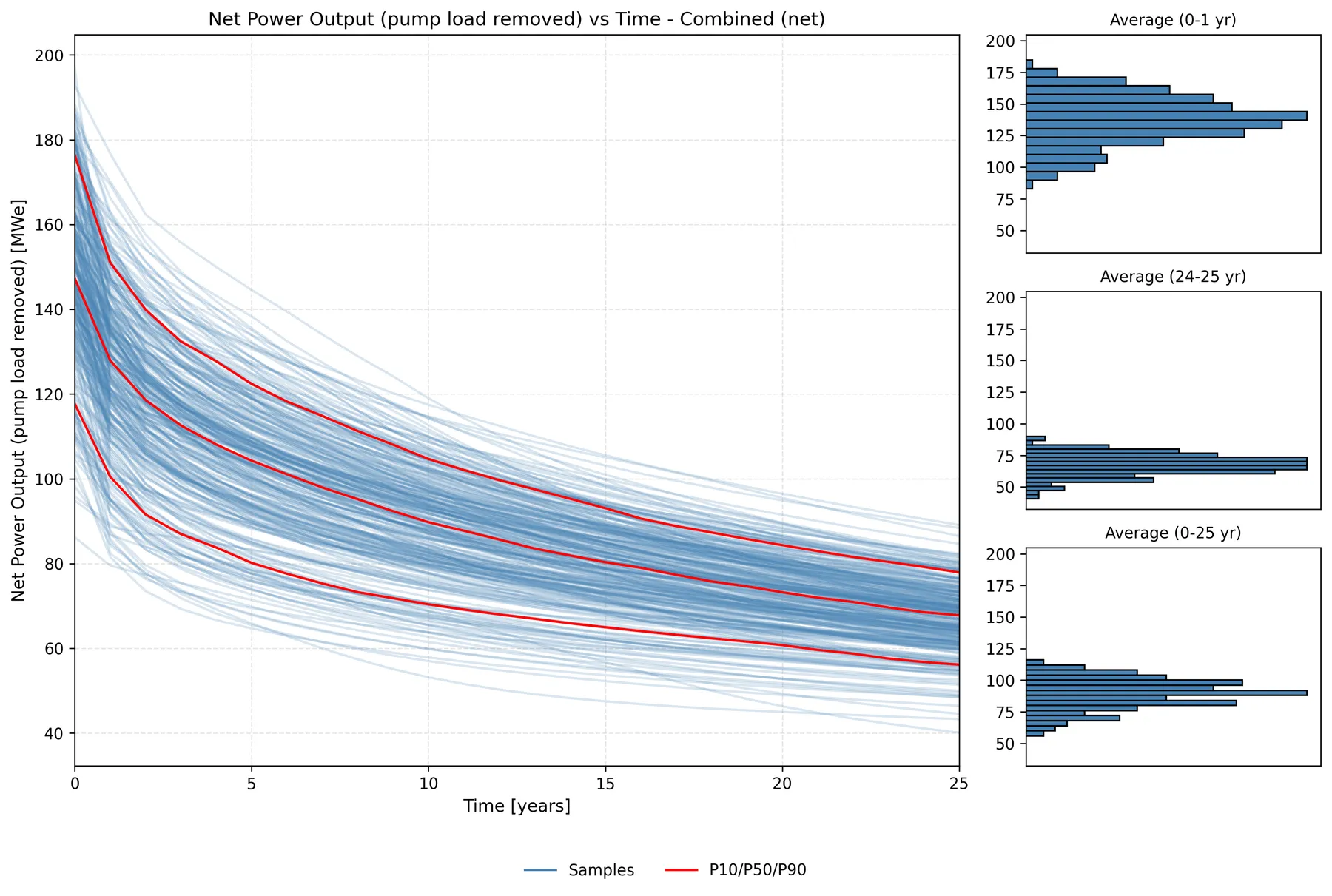
Combined net power output forecast, 25-year horizon, 293-sample ensemble with P10/P50/P90 bands

Combined net power output, 25-year forecast, 293-sample ensemble — grey: individual samples; red: P10/P50/P90

P1071.4 MWe
P5089.9 MWe
P90104.4 MWe

25-year time-averaged net output across the ensemble (mean 89.3 MWe)

From our own in-preparation manuscript on Tecuamburro–Infiernitos combined resource assessment — not yet peer-reviewed.